Sample Reasonable Compensation Report — See what you get.
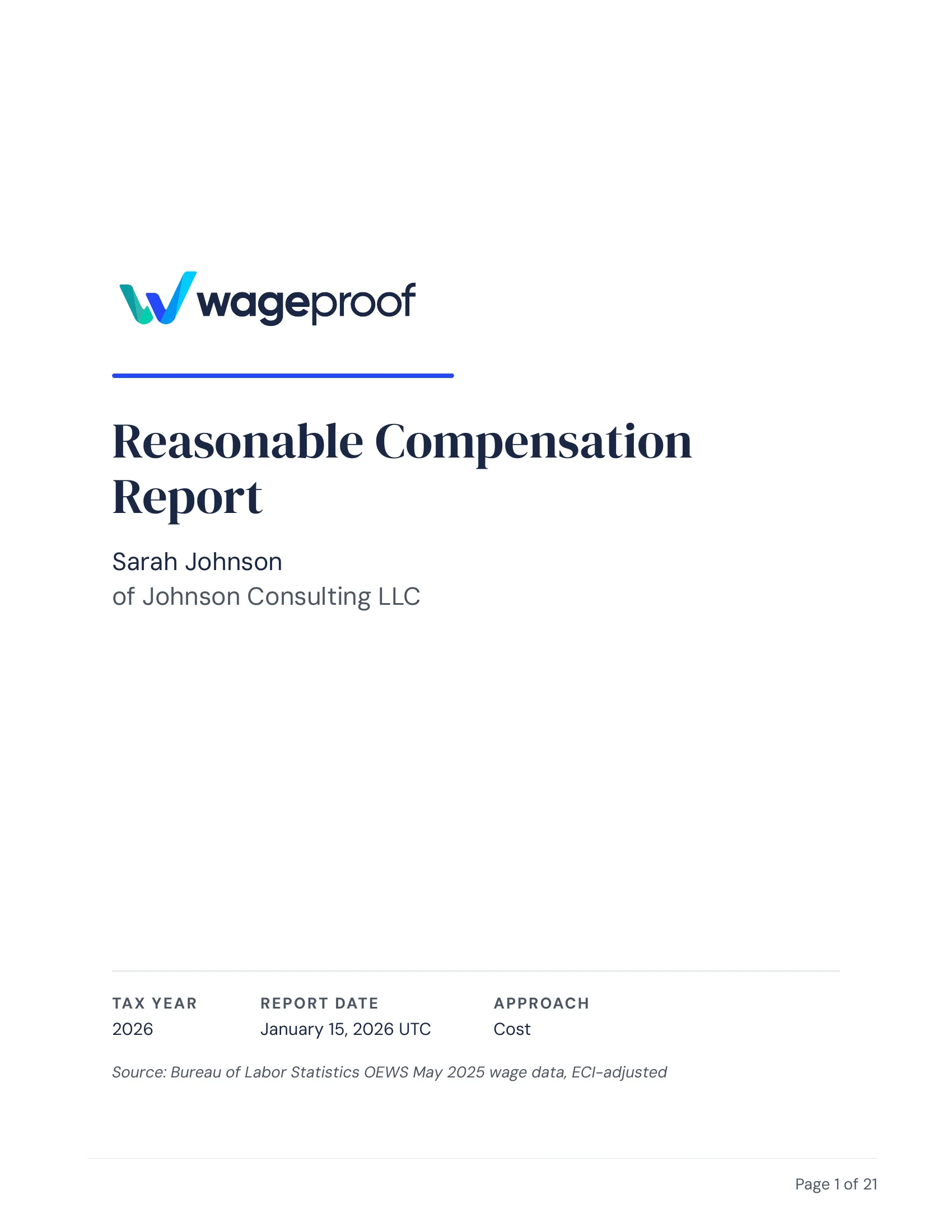
This is a real report generated by the tool. Same format, same data sources, same methodology documentation you'll get in yours. This sample uses the Cost approach; WageProof also builds reports using the Market and Income approaches.
Both files are the Cost approach sample.
White-labeled PDFs replace the WageProof brand with your firm’s logo and colors — available on Professional and Firm plans.
The Cost, Market and Income approaches
This sample
Cost Approach
Prices each task in the role separately, using local wage data.
Market Approach
Compares the role to one comparable occupation in the area.
Income Approach
Weighs the pay against the company's financial return, for tax professionals.
What is a reasonable compensation report?
A reasonable compensation report is a written analysis that documents a defensible salary for an S-corporation owner-employee. It matches the owner’s actual duties to market wage data from the BLS Occupational Employment and Wage Statistics program and shows the work, so the number can be supported if the IRS questions it.
S-corp owners are required to pay themselves reasonable compensation for the work they do before taking tax-advantaged distributions. A reasonable compensation report is how you set that figure on evidence rather than a guess — and how you keep the contemporaneous documentation an examiner will credit. The sample below is a real report, with its main pages annotated.
The report’s main sections
- Executive Summary
- The compensation figure, what it's based on, and what the analysis covers.
- Approach Detail
- Which approach (Cost, Market or Income) priced the figure, and the calculation behind it. Here, that's one row per task: the occupation code, the experience level, the hours and the rate.
- Sample Written Consent
- A written consent for an LLC's members to sign, or a board resolution for a corporation's directors.
- Full Methodology
- The standard the figure has to meet, and every step of the calculation. Also covers what the analysis doesn't do, and lists every source.
- Supporting Tables
- How that methodology applies to this report: what you entered, the data looked up, any substitutions made, and the final calculation.
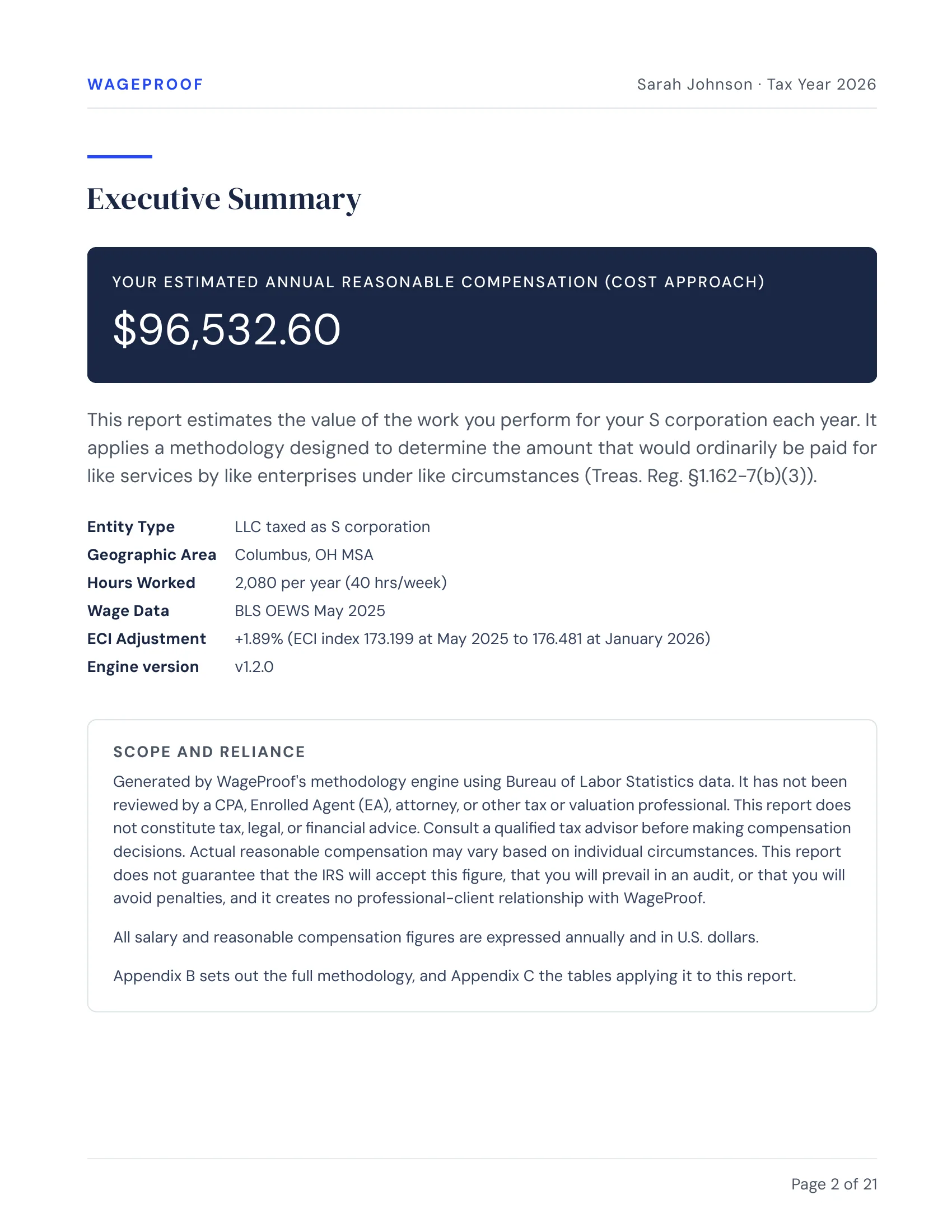
Executive Summary
The bottom-line number, with the approach used and the data sources right beside it.
Entity type, wage area, hours worked, the BLS release and the wage-growth adjustment: the facts the number depends on, right underneath it.
The Cost Approach methodology and the BLS OEWS data year, both labeled.
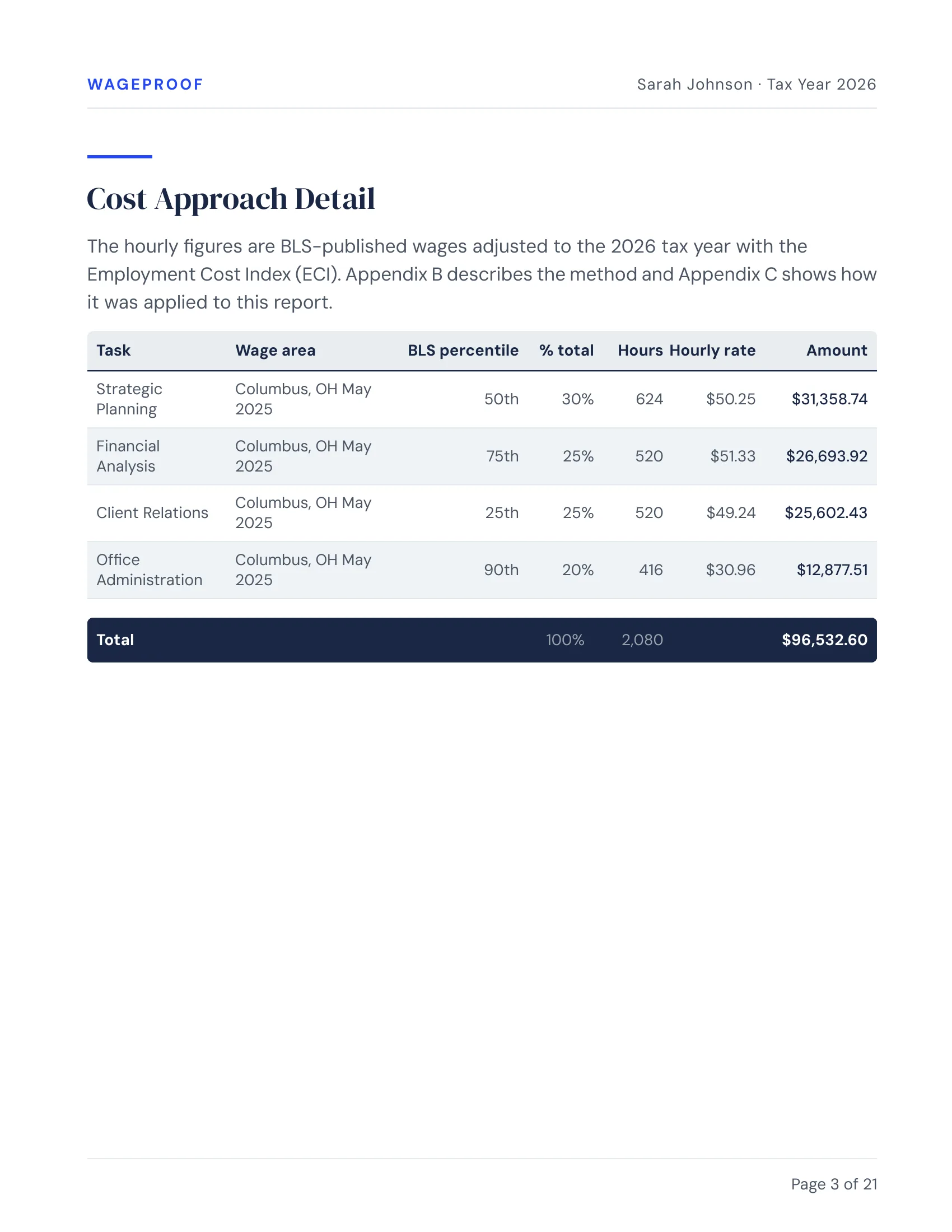
Cost Approach Detail
Every task links to a specific Standard Occupational Classification code with its full title.
Experience rating (1-5) maps to a specific BLS wage percentile (10th through 90th).
Hours worked x hourly rate = the annual wage for each task.
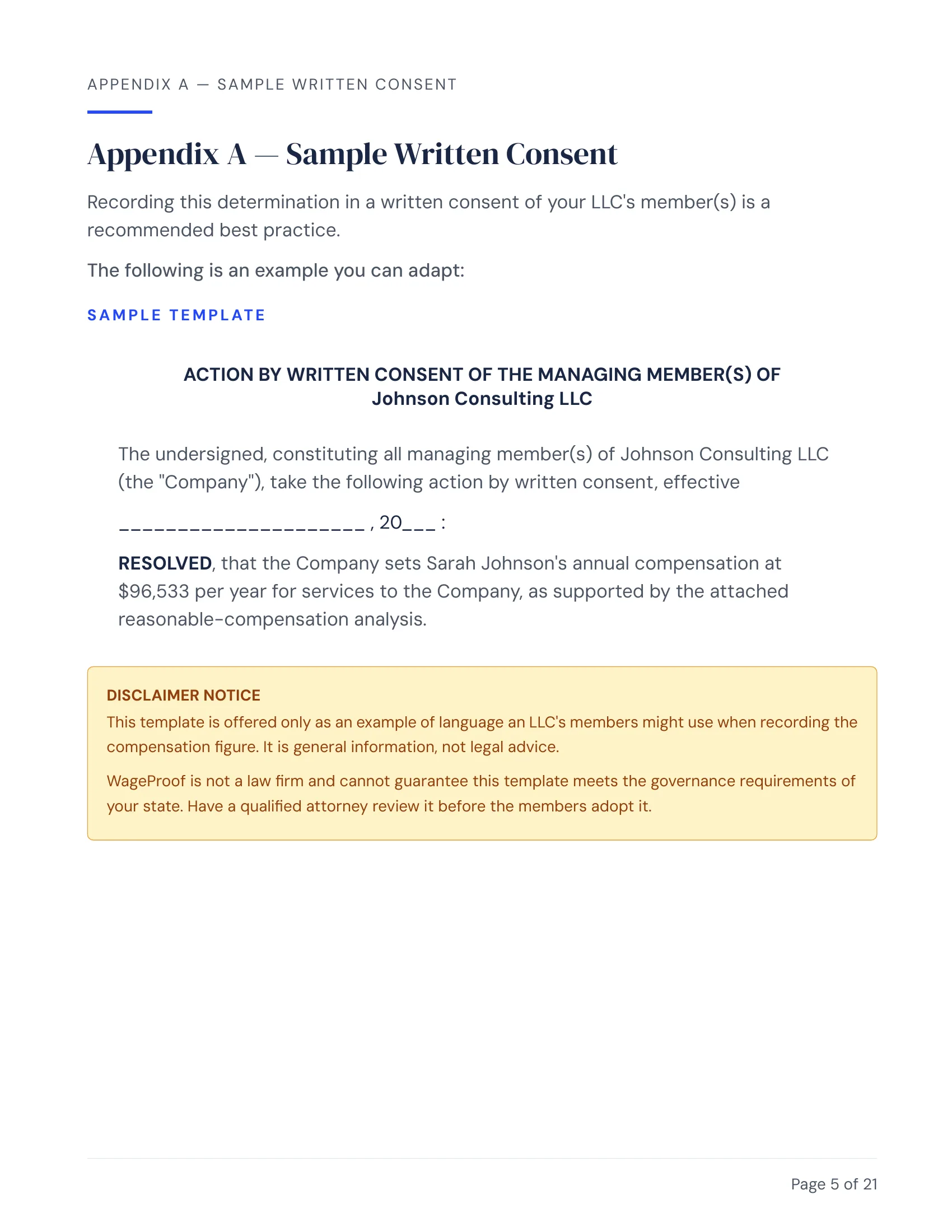
Sample Written Consent
A written consent for an LLC's members, a board resolution for a corporation's directors, each with its own officer titles and format.
Print, sign, and file it with the company's records. No additional drafting needed.
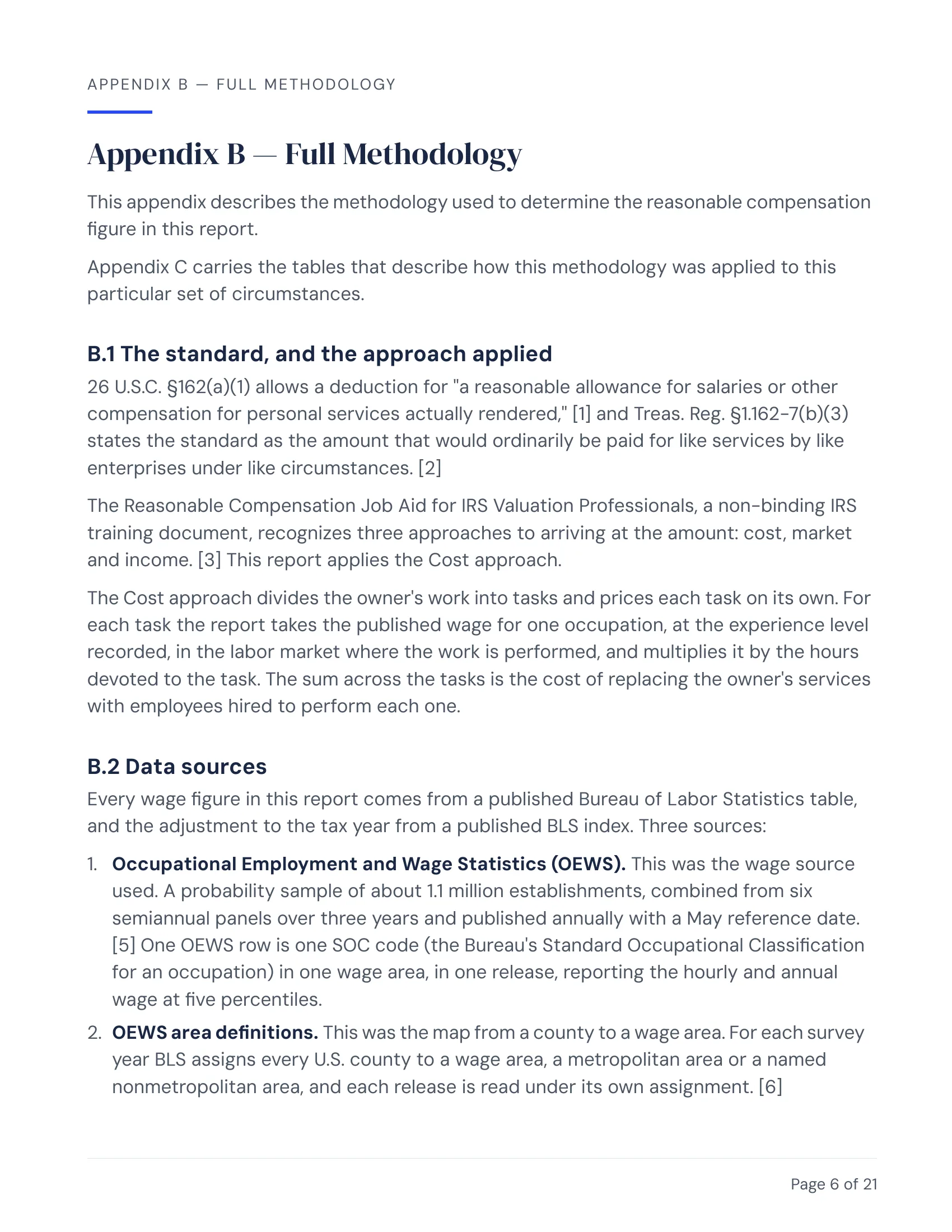
Full Methodology
26 U.S.C. §162(a)(1), IRC §3121(d)(1), the Treasury regulation that defines the standard, and IRS Fact Sheet FS-2008-25, quoted where they apply.
The factors the IRS fact sheet lists, and which of them this report reaches, plus what in the report reaches each one.
Numbered sections for the inputs, the published data they are read against, how work is mapped to occupation codes, how a published wage is found, what happens when a figure is published as a cap, the adjustment to the tax year, and the final arithmetic.
A limitations section stating the analysis's boundaries, and a numbered reference list so each source can be looked up.
Reasonable compensation report FAQ
A reasonable compensation report is a written analysis that documents a defensible salary for an S-corporation owner-employee. It matches the owner's actual duties to market wage data — the BLS Occupational Employment and Wage Statistics program is the one most commonly used — and shows the methodology so the figure can be supported if the IRS questions it.
What reasonable compensation means →A WageProof report opens with an executive summary carrying the bottom-line salary figure, then an approach detail page mapping each task to a BLS occupation code and wage percentile. Appendices follow: a ready-to-sign written consent or board resolution matched to the entity type, a full methodology setting out the standard and every step of the calculation, and supporting tables showing that method applied to this report's own figures. The annotated sample on this page walks through them.
Any S-corporation owner who works in the business and takes distributions should be able to support their salary, and the CPAs, EAs, and tax advisors who advise them use these reports to set payroll and build an audit file. It's most valuable as contemporaneous documentation — prepared when you set the salary, not after an audit notice arrives.
WageProof charges a flat fee per report — no subscription is required to generate a single report. Professional and Firm plans for tax pros add white-labeling and volume pricing. See the pricing page for current tiers.
See pricing →The report documents a transparent methodology, ties every wage figure to a published BLS source, and includes a board resolution — exactly the contemporaneous, data-backed record examiners look for. Reasonable compensation is a facts-and-circumstances determination, so no report can guarantee an audit outcome, but a documented, market-based analysis is far stronger than an unsupported number. It is not a substitute for advice from your own tax professional.
How the calculation works →Download the full sample. Or generate yours.
See a full report, no email required. Two versions — standard, and white-labeled for tax and accounting firms.